

Client Question: Battle to Lower Rates
July 24, 2025
If you’ve been following the news lately, there is considerable coverage of the Administration’s desire to lower interest rates – which has been largely messaged as a campaign to replace Fed Chair Powell with another Fed Chair who would possibly be more amenable to lowering interest rates.
President Trump visited the Federal Reserve offices today to see the renovations that are underway (many believed cost overruns for the renovation could serve as a justification to dismiss Powell for cause before his term ends). During a stunning press conference after the site visit, Trump denied the need to fire Powell stating “To do that is a big move, and I just don’t think it’s necessary.” He quickly added “I believe that he’s going to do the right thing” – meaning lower interest rates.
All of this back and forth has (rightfully so) caused confusion with the investing public. A client asked me this week why the administration is so concerned with lowering rates and what all this fuss is really about.
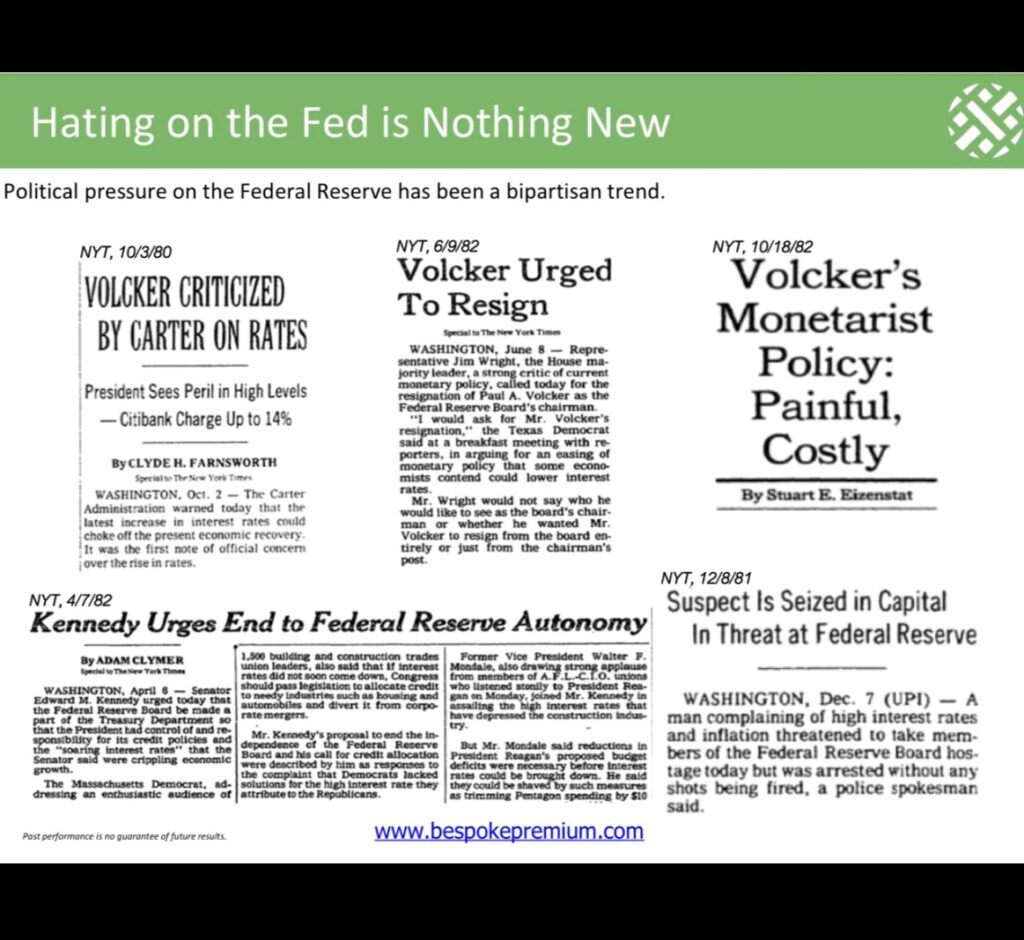
(Before diving in, it’s interesting to note that this is not a new battle. This graphic, courtesy of Bespoke Investment Group, shows how past administrations have had a similar concern)
The Federal Reserve Bank is meant to operate independently of the Federal government and controls monetary policy (ie: the setting of short-term interest rates and control of the money supply to manage inflation and employment). The federal government gets to control fiscal policy (collecting taxes and spending funds to manage underlying demand and growth of the economy).
Given it’s critical role in the economy, it has been a long held belief of the US (and other major countries) that monetary policy should remain out of the hands of government in an effort to shield it from politics and election cycles (which can clearly have a drastic impact as we have seen on the fiscal policy side). However, this does not stop elected officials (including the President under both parties – see above) from attempting to influence the Fed and its monetary policy decisions.
At the present moment, there is considerable pressure from the Administration for the Fed to lower interest rates? Why? Because typically, lower interest rates encourage more spending and borrowing – when it’s cheaper to access money, people and businesses tend to access more money – which leads to higher growth.
While it’s true the Fed only controls the Fed Funds rate (very short-end/maturity of the yield curve) typically other rates (such as those on credit cards, car loans, certain mortgages, etc) will also decline in response to the Fed lowering its benchmark rate. As a result, a lower Fed Funds rate should make overall borrowing cost lower, which leads to more spending and greater economic growth. Simply put, lowering rates tends to help economies grow at a faster clip than they would otherwise.
Here’s a recent example of what lower rates do.. Remember the immediate post COVID response? Fed officials ultimately cut rates to zero. This made it incredibly affordable to borrow money – whether it was car loans, mortgage loans, home equity lines, etc. During a very difficult time when economic activity virtually halted in the country, Fed officials took action to encourage borrowing (and spending) to revive the economy. And it worked..arguably too well as the economy roared back (story continues below!)
Why would the Federal Reserve not want to lower rates right now? Are they anti economic growth? No. Of course the Federal Reserve Bank wants to US economy to thrive and expand. However, the Fed is tasked with two mandates that also play an important role in the long term growth prospects of the economy- stable prices (ie: inflation under control) and full employment (a healthy and functioning labor market). Their objective is for the level of interest rates to achieve those two mandates, while also supporting the long-run growth of the US economy.
If they move too fast or too slow in cutting or raising rates, they run the risk of damaging the stability of prices, the labor market, or both. Let’s go back to the 2020 example. Cutting rates upon the initial COVID lockdowns was a great move and worked very well, however, in hindsight, it’s obvious what the negative ramifications of rates being “too low for too long” were – remember inflation rates over 9%? When money was virtually free (ie: zero % Fed Funds) and supply chains were disrupted, there were too many dollars chasing too few goods = record breaking inflation.
As of today, the Fed remains concerned that there could be a repeat of that inflationary picture (at a lesser magnitude) – mainly due to the lingering threat of tariffs. And quite frankly, with the labor market holding its own as of now, inflation still above the 2% target, and the US economy holding its own at a 2-3% growth rate, the Fed doesn’t face an urgent fact pattern that necessitates a cut.
However, the political machine in Washington never stops and the midterms are now just over a year away. So it’s only natural for elected officials to want to spur added economic prosperity for their constituents and in their view, cutting rates is a quick way to do that. In my view, the separation of monetary and fiscal powers is an important one – in the US and in other major economies – and I am hopeful it will remain intact.

Leave a note