

A Wild Week
March 5, 2026
Phew, today brings a whole new meaning to “TGIF!” As an investor, weeks like this can feel likes years and it will be nice to have a two-day respite from real-time market pricing. Markets were faced with navigating the ever-changing fact pattern in the Middle East this week and given the lack of clarity on scope and duration of this conflict, volatility prevailed. Several trading days saw massive intraday trading swings as investors attempted to price (unsuccessfully) the events as they transpired.

As we wrote about in today’s Client Question post, historically, investors have usually been well served by largely ignoring geopolitical events. However, that doesn’t make them any less confusing and concerning to navigate. And of course – there is always that slight chance that this time could be different.
Adding to the price action is the fact that the Iran conflict isn’t the only item of interest for markets this week. Here are a few others of note:
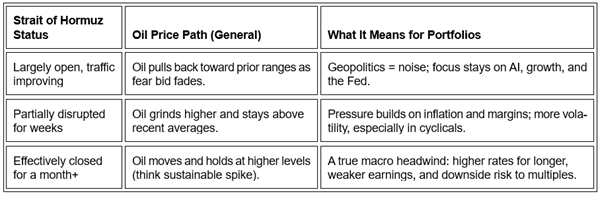
Energy pricing – as written about in above-linked post, the Strait of Hormuz (situated in the middle of this conflict) is a major highway for global energy. If the Strait remains effectively closed (no one can “close it” but ships can avoid it for obvious reasons) for an extended period of time, that is likely to have a material impact on energy prices. Higher energy prices translate into higher inflation and potentially higher interest rates and lower growth. Not a great combination. Below chart from a newsletter publication gives some high level scenarios that could transpire depending on how long the “energy highway” remains closed. Clearly, duration matters here
Inflation picture– Wholesale inflation for February (PPI) was released last Friday and was not an encouraging report. A 0.5% increase in the month was higher than anticipated and the 2.9% increase year over year seems to reflect the impact on goods pricing of tariff policy (as energy and food fell in the same period). Concerns about energy prices – on top of this hot reading – are reigniting inflation discussions
Employment picture – The February jobs report will be published tomorrow (likely around the time you’re reading this). The private payrolls report from earlier this week showed the strongest level of job growth in seven months. If that strength continues to the jobs report, it casts further doubt on the need to cut rates anytime soon (especially when taken together with inflation concerns)
US Economy – On Wednesday, the US economy received some positive news as the ISM services index (a measurement of the health of the US manufacturing and services sector) rose to the highest level since 2022. Many noted this would be consistent with GDP growth of more than 3% in 2026 – not bad even if below the Administration’s predictions of 5-6%. But again, all of that could be disrupted by a prolonged energy price spike
Tariffs – After the Supreme Court’s ruling on President Trump’s tariff policy a few weeks back, there was a threat of 10% – and then 15% – blanket tariffs for 120 days. Treasury Secretary Bessent confirmed this week that is still the plan – and that these charges would start this week. Further, the Court of International Trade seemed to lay the groundwork this week that tariffs will need to be refunded (likely with interest).
Uncertainty Overload– Overall, this week is a classic illustration of how much markets dislike uncertainty. Isn’t life always uncertain? Yes. But can markets seemingly ignore that fact at times – also yes. However, this year – with the ongoing concerns of AI disruption, private credit hysteria, elevated valuations, changing of the Federal Reserve guard, tariff back and forth, midterm season, and now Iran – markets seem to be losing their ability to tune out all of this noise. This uncertainty can be an opportunity – but is also very unsettling and hard to watch.
Now that I’ve reminded you of all these is to be aware of after this wild week, you may be wondering – what do I do now? Here are a few things you my wish to consider (as always, filter for your own circumstances, risk tolerance, and overall financial plan)
You don’t have to do anything – Sometimes – reading, thinking, evaluating, considering, and then doing absolutely nothing as a result can be a great investing approach
Opportunity rarely feels good at the time – Putting new cash to work with flashing red on the screen, harvesting a loss, adding to an oversold name – none of these actions labeled as “opportunity” feel very good at the time. Focus on the long run and take advantage of a few ideas while you still can
Keep your shopping list handy – I’ve heard clients lament “missing out” on certain names and sectors in the past few years. Don’t look now – but many of those are now on clearance racks. Do your homework and don’t try to time the exact bottom or “be a hero” but certainly keep a shopping list handy
Refocus on quality – Uncertainty can take down the entire market, including the companies that are well positioned to weather it and thrive after it passes. Find the businesses with ironclad customer bases and brands, consistent (and growing) cash flows, durable earnings power, aligned management teams, and returns on capital that exceed their costs of capital. Spend some time evaluating their pricing versus their future value
Remember fixed income – the golden age of fixed income lives on. Rates have backed up this week (with inflation concerns beating out the flight to safety trade). Pay attention to duration and credit quality, but the prevailing yields and likely total returns in this asset class are very compelling
Above all else, don’t forget that you’ve survived countless wild weeks up to now. No reason to believe you won’t do so yet again.
Onward we go,


Leave a note