

Client Question: Free Cash Flow
July 28, 2026
When talking with a client last week about equity markets and their recent price action, I brought up the topic of free cash flow. It warranted added discussion then and I figured it would make a good client question post as well.

Free cash flow is the cash left over after a company pays for its operations and capital expenditures our of its revenue/income. (Same goes for your own free cash flow – it’s the cash you have left after you take taxes and expenses out of your salary/other earnings).
In the years before the AI boom and buildout, some of the largest companies in America had staggering amounts of free cash flow. Companies such as Google, Meta, Apple, and Microsoft were famously known as “asset light” businesses. They earned incredible amounts of cash from operations and their main expenses were salaries. They had very little need for any capital expenditures and as a result, their free cash flow levels were astronomical. However, as the AI race began, many of these businesses turned into what the market is calling “hyperscalers” – spending massive amounts to build out data centers and AI models to rapidly scale their businesses for this new era. As the capital expenditures have grown, their free cash flow levels have fallen as many of them are choosing to fund the costs with current cash versus borrowing.
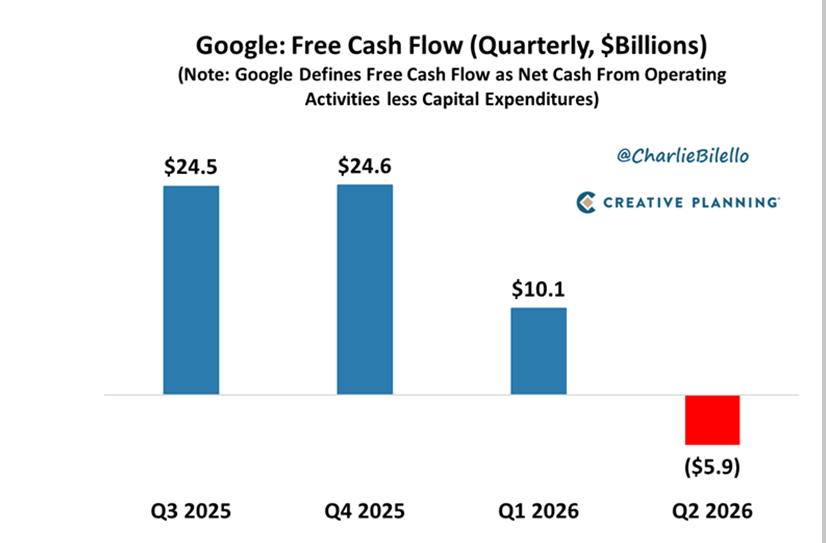
Markets appear to be taking notice. Last week, as an example, Google announced its highest revenue quarter on record and yet it’s stock fell meaningfully after hours. Why? While it could be due to a variety of factors and broad market forces, it may also be due to the fact that Google’s free cash flow turned negative for the first time in company history and it announced no slow down in cap ex, explaining plans to spend $195-$205 billion in cap ex for the year.
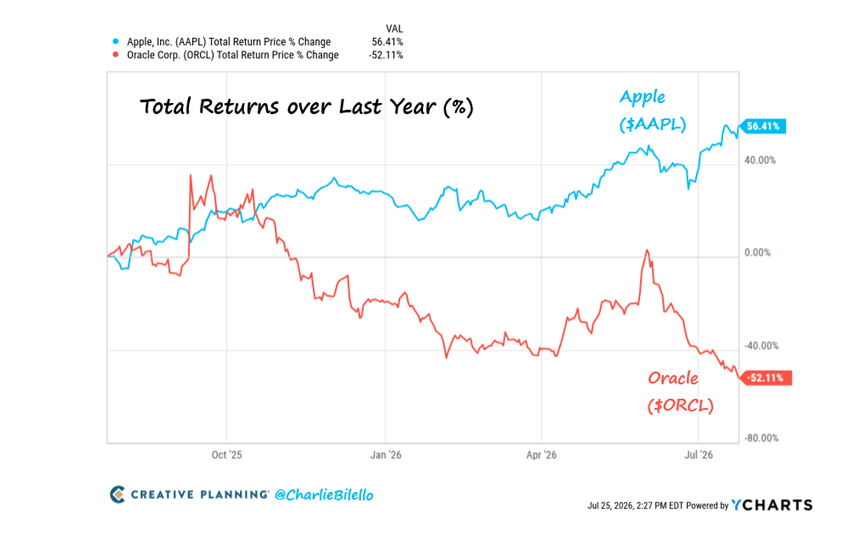
Meanwhile, other major companies are not spending as aggressively and appear to be rewarded by markets. Take Apple as an example. After being dismissed and somewhat mocked in the past few years for not being a leader in the “AI race,” its stock is at record highs. This chart shows Apple’s performance (as they have earned $129 billion in FCF) versus Oracle’s (as they have spent $24 billion in FCF)
Why would FCF impact stock performance? A high level of FCF gives companies the same thing it gives us as individuals – a high level of financial flexibility and durability. The more cash you have, the more options you have to act and react to what the future brings your way.
However, I believe the bigger question at hand is markets are attempting to decipher whether all the cap ex being invested into the AI buildout will ultimately pay off. That is a very large question and one that is impossible to answer right now – which is why we’re seeing such volatile moves in markets from quarter to quarter and day to day. AI will change the face of our economy and our lives – but attempting to value that change is proving to be quite challenging. As of now, many businesses are taking the stance that they can’t afford to be left behind. Time will tell if this is a reasonable stance to take.

Leave a note