

Client Question: Returns
December 16, 2025
As we approach the end of 2025, I had a good discussion with clients about returns and various ways to evaluate them. I thought it would be a helpful discussion to share
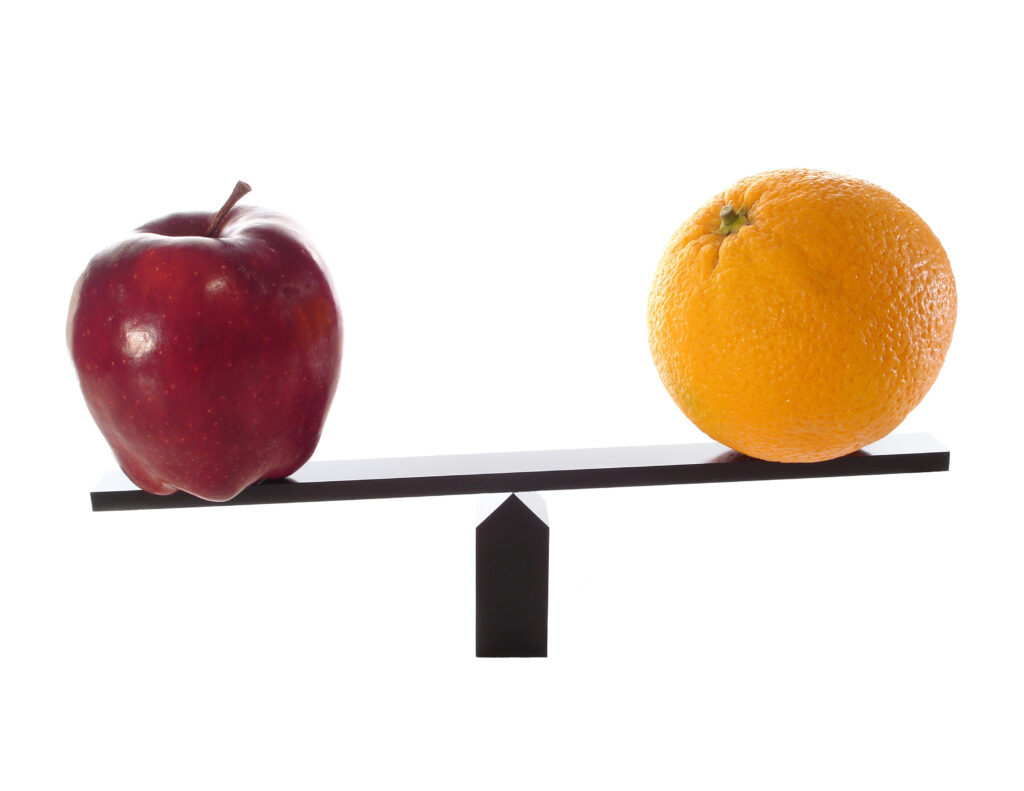
This picture is the perfect one to summarize the concept of market returns and how to evaluate returns. As the famous saying goes – let’s be sure we’re not trying to compare apples and oranges!
What is my return?
If you are an investor, you are taking cash and exchanging it for a variety of securities (cash, bonds, stocks). You are likely doing this across a variety of accounts (a brokerage account, an IRA, a 401k, etc). Your return is the change in the aggregate value of all of those accounts during a set period of time. This return should include income from investments (interest or dividends) and appreciation or depreciation in the fair value of those investments. However, it should exclude the impact of cash contributions (ie: money put into the account) or distributions (money taken out of the account).
How do I calculate my return?
Windermere uses software to calculate returns for client portfolios on a daily basis across their aggregate accounts. This provides a very accurate return (as it takes into account the day on which the activity occurs). If you are managing your own money, you can do a simple return calculation (ending value less beginning value/beginning value) but be sure you are adjusting for inflows/outflows as close to their date of occurrence as practicable.
Note: certain custodians may provide returns to investors but they are often on an account only basis or do not properly exclude cash flow impacts.
Absolute vs Relative Returns
Once you know your return, the question is how do you evaluate it? An absolute return is your return on a standalone basis. For instance, let’s assume your portfolio generates a 7% return. 7% is your absolute return. If I ask you if that was good or bad return, your next question should be – compared to what? The comparison of your absolute return to some other metric (known as a benchmark) is the relative return. Continuing the example above, let’s say your benchmark is 5%. Your relative return is 2% (7-5 = 2)
This is arguably the more important return – but choosing the right benchmark is critical in having a relative return that is meaningful.
Benchmark Selection
Again, your relative return is your absolute return less a benchmark return. Knowing that, the benchmark you select is going to dictate how you feel about your performance. How do you choose a benchmark?
A benchmark should be relevant for your specific situation. For our clients, I focus on two main benchmarks. The first is a weighted average return of their target allocation. If their targeted portfolio (simplified for illustration sake) was 5% cash, 35% fixed income and 60% US stocks, their benchmark return would be the sum of (5% 90-day T bill return) + (35% US aggregate bond index return) + (60% Russell 3000 index return). This shows what their return would be if invested at their target allocation. \
The second – and perhaps more relevant benchmark -is the return needed to achieve clients long-run objectives determined in their financial planning model. For example, based upon a client’s needs/wants, income sources, and current portfolio value, it is determined that a 6% return on their investments will allow for them to spend at their desired level for the rest of their lives (thereby meeting their goals). This 6% is a great benchmark to focus on as that is really what is needed to reach their goals. Excess returns are nice – but this is their “line in the sand.”
Please note that in both of these benchmark explanations, the return was dictated by a client’s specific portfolio and/or long-run objectives. The benchmark is not some arbitrary metric (such as the return of the S&P 500 (when their portfolio is only 50% invested in stocks!) or the return of their neighbor or “as high as possible”). As we started this discussion with – don’t try to compare Apples with Oranges!
Hopefully this explanation of returns helps and allows you to carefully and meaningfully evaluate your 2025 absolute returns!

Leave a note