

Client Question: Sector Rotation
February 11, 2026
As we’ve discussed every week thus far in 2026, it has been a wild start to the year as far as markets and the economy are concerned. This is leading to all sorts of new topics coming to the surface. A client asked about one of these subjects this week – Sector Rotation.

What are sectors?
Before diving into the concept of sector rotation, let’s back up and explain sectors. A sector, when it comes to investing, is defined as a large, distinct segment of the economy containing companies with similar business activities, products, or services. In the US equity market, there are 11 sectors. As the companies within the sectors do better (or worse), the sectors grow or shrink as a percentage of the US economy. As of January 31, 2026, here are the US stock market sectors (from largest to smallest)
Information Technology 33.4%
Financials 12.9%
Communication Services 11.0%
Consumer Discretionary 10.4%
Health Care 9.4%
Industrials 8.6%
Consumer Staples 5.0%
Energy 3.2%
Utilities 2.2%
Materials 2.0%
Real Estate 1.9%
What does sector rotation mean?
Each of the sectors in the market will perform differently in certain time periods. Sector performance can be influenced by a variety of factors, including stages of the economic cycle, company-specific dynamics, investor sentiment, macro-economic events that impact different sectors to different degrees, trading technicals, and countless other factors. When an investor adjusts which sectors they favor/invest in, this is known as sector rotation (moving from one sector to another).
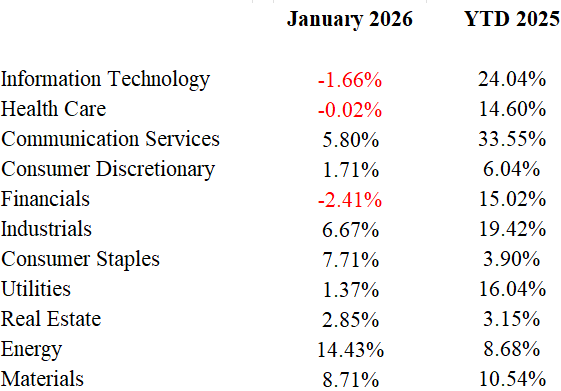
As of late, there is considerable discussion that investors are rotating from the sectors that have led the US equity market in recent years (focused on Technology, Consumer Discretionary, and Communication Services) and rotating/moving investments into “unloved” sectors of years gone by – such as materials, industrials, and energy. Oftentimes it becomes a “chicken or egg” discussion – does the sector rotation cause the new “hot” sectors to do start outperforming, or do the sectors perform better and the rotation follows? Likely a combination of both – but either way, you can see some of the relative laggards in 2025 are now leading the way in 2026 thus far – and that the strongest sectors in 2025 are giving some back in January 2026.
Hopefully this helps outline what sector rotation means. As to the next question (should you be doing this with your portfolio), as always, reach out to your advisor and/or do your own analysis for your unique portfolio and financial objectives!

Leave a note