

Client Question: What’s Happening with Bond Market and Interest Rates?
August 26, 2026
It’s not often that I receive more client questions about bonds than stocks, but that has certainly been the case the past few weeks. Interest rates (and their relationship to bonds) has been the hot topic! Let’s look at a few things that have been discussed.
Remind me the relationship between rates and bond prices?
The inverse relationship between bond prices and interest rates can be a bit confusing. You would think that as the rate of interest you get paid goes higher, so do bond prices. But in fact, the opposite is true. As rates move higher, the prices of bonds falls. This is due to the fact that the rate you were earning on that existing bond is now lower than the rate you can get paid on a new bond (since rates have moved up). As a result, that “promise to repay” that you hold with a lower interest rate than is available today is worth less. Of course, if you hold an individual bond and plan to do so until maturity, the moves in price are simply fair value marks. If the borrower stays solvent, you will collect your principal and interest at maturity. However, much like stock prices that move every second, the fair value of your bond is what it is worth at that moment and you are losing economic value as rates rise – even if you will breakeven upon maturity. The movement of rates greatly influences the price of bonds.
Why are rates going up?
We started 2026 with a legitimate belief that rates were likely to go down – not up. What has changed? Of course, there is no way to know for certain what is driving rates higher but many will offer their well-educated opinions as fact. Here are a few of the possible contributors. In reality, it’s likely a combination of all of the below items (at varying weights)
- US deficit – As the US deficit passed $40 trillion last week, a discussion of the debt’s impact on rates took center stage. Deficits are not a great signal to markets of credit worthiness and as a result, may trigger higher interest rates (ie: markets view the US are a riskier credit). However, consider that the national debt has been rising for years (it has increased $25 trillion in the past two decades) and as of today, long-bond yields are at the same level they were when the debt was $8 trillion. The market’s reaction to debt doesn’t appear to be the driving cause but it may play a role
- Inflation – Inflation expectations can also drive up longer-term rates (as investors will demand higher real returns to offset inflationary impact). Concerns over inflation – as well as confusion over Fed Chair Warsh’s “less is more” communication style- are potentially pushing rates up at the longer end of the yield curve
- Illiquid market – There are not a lot of 30-year bonds available in the market – and the ones that are issued do not trade very frequently. An illiquid market tends to be more volatile and is not as reliable of a barometer as a liquid market is (like the one for T bills as an example)
- Bond issuances driving up supply – Up until a few years ago, there did not appear to be enough fixed income issuances to meet demand from retail and institutional buyers. However, that has changed drastically in recent months as some of the largest companies in the US have begun accessing the debt markets to fund their AI cap ex. As more and more issuances hit the market, supply outpaces demand, which leads to higher rates
- Fed behavior – As mentioned above, Fed Chair Warsh has taken a new stance regarding communication and is choosing to not give markets much insight into what the Fed thinks or plans to do. This change – and resulting ambiguity – may be placing an uncertainty premium in yields on the long end of the curve.
What is the Treasury Department doing?
The Treasury Department is effectively buying back 30-year Treasury bonds ($2 billion now and says it will go up to $4 billion in September). The action itself is an attempt to bring down rates at the long end of the yield curve and the announcement that there might be more to come is an effort to signal forward guidance to markets. One interesting sidebar I read this week is that the Treasury Department can’t make money to complete these purchases, so it has to issue short-term bonds to pay for its purchase of long-term bonds. One article I read described the plan as follows: “The Treasury Department is consciously and purposely trying to manipulate term premium in the bond market to effect a policy objective.”
What way will rates go next?
Predicting the direction of rates and the magnitude of the moves is very hard. Almost impossible. Rates could keep going up, as could inflation, and bonds will suffer. However, there are also scenarios in which rates fall – and fall fast (war could end, trade deals could be reached, inflation could fall, recession could start, etc). The minute someone tells you definitively which way rates will go is likely the moment right before they move the other way. No one knows what will happen.
Do I need to avoid bonds?
In my opinion, bonds remain a key asset class within a diversified portfolio. Of course, this will depend on your specific fact pattern and objectives. However, bonds are a key source of income/cash flow for many investors and importantly, in times of economic stress, bonds have been proven to “work” – ie: a flight to safety drives up demand which lowers rates and causes bond prices to rise.
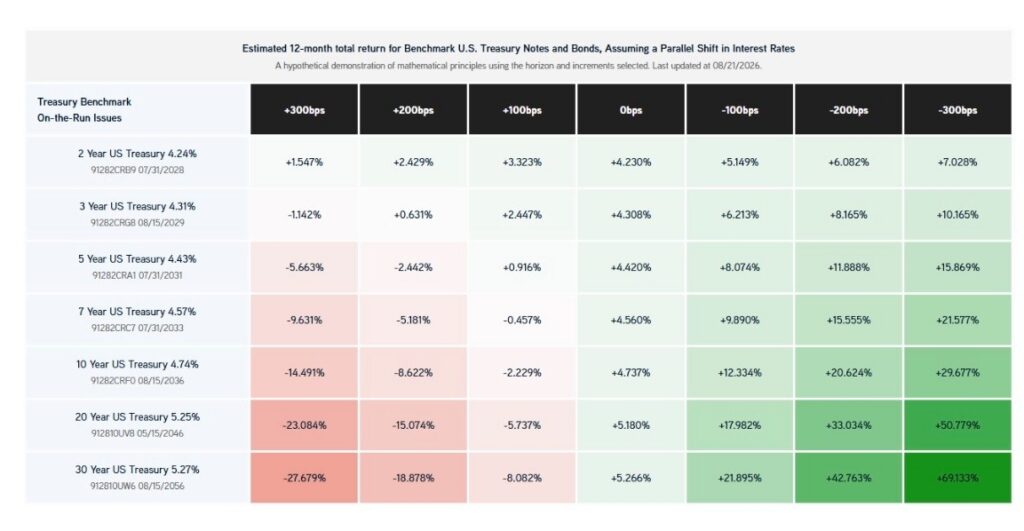
As for timing of investment today, the good news for bond investors today is that the current level of yields gives a meaningful margin of safety before total returns will become negative. Your total return on a bond is comprised of the yield/coupon (ie: stated rate of interest on the bond) and the price change (due to movements in the yield curve while you hold the bond). While the price changes have been negative as of late as rates have risen, the coupon payments are coming close to offsetting those losses – especially at shorter durations.
The below chart attempts to illustrate what could happen to various bonds if rates were to rise or fall from here. As you will see – the upside exceeds the downside in all cases for a given rate change (due to the coupon impact) – and the potential losses (and gains) are far greater the longer the duration of the bond
What should you take away from all of the above? Bonds are an investment option that deserves careful attention and analysis, just like all other asset classes. They are not simple, nor are they “set it and forget”. They can be celebrated as rates fall and overlooked and maligned as rates rise (with seemingly no end in sight).
However, as always, it is well worth your while to resist the urge to blindly accept the current narrative without doing your owned work. There may come a time in the not so distant future when you’ll be grateful to have bonds as part of your blended portfolio.

Leave a note